

Large local music libraries are harder to manage when the player treats everything like a disposable stream instead of a collection you actually maintain. That is what makes it useful to install Strawberry on Ubuntu, because Strawberry Music Player focuses on library management, MusicBrainz lookups, smart playlists, and bit-perfect playback.
Strawberry is a fork of Clementine, which explains why that older name still shows up in search results and forum threads. Ubuntu 26.04 and 24.04 ship Strawberry in Universe, while Ubuntu 22.04 needs the Strawberry PPA or Flatpak. The official Strawberry site also lists Linux downloads, but the package-managed routes here are easier to update and remove cleanly on Ubuntu.
Install Strawberry on Ubuntu
Three installation paths make sense on current Ubuntu LTS releases. The default Ubuntu package is the simplest route when it exists, the Strawberry PPA keeps APT on the latest stable branch, and Flatpak gives you the same sandboxed build across every supported release.
| Method | Channel | Version | Updates | Best For |
|---|---|---|---|---|
| Ubuntu repositories | Ubuntu Universe | Distribution default | Automatic via apt upgrade | The simplest package-managed install on Ubuntu 26.04 and 24.04 |
| Strawberry PPA | Jonas Kvinge Launchpad PPA | Latest stable | Automatic via apt upgrade | Ubuntu 22.04 users or anyone who wants a newer APT build |
| Flatpak | Flathub | Latest stable | Automatic via flatpak update | A sandboxed install with the same app version across supported Ubuntu LTS releases |
- Use the Ubuntu repositories on 26.04 or 24.04 when you want the shortest APT workflow.
- Use the Strawberry PPA on 22.04, or when you want the current stable branch through normal APT updates.
- Use Flatpak when you want the same Strawberry release on every supported Ubuntu version or prefer a sandboxed app lifecycle.
Ubuntu 26.04 and 24.04 include Strawberry in Universe, while Ubuntu 22.04 returns no default package candidate and needs the PPA or Flatpak instead. All three methods install cleanly from a terminal, but Strawberry still needs an active graphical session to launch the desktop interface.
Update Ubuntu before installing Strawberry
Refresh APT first so the package index and any pending base-system updates are out of the way before you add or install anything else.
sudo apt update && sudo apt upgradeThese commands use
sudofor root privileges. If your account does not have sudo access yet, follow the guide to add a new user to sudoers on Ubuntu before continuing.
Install Strawberry from Ubuntu repositories
The default APT package is the easiest path on Ubuntu 26.04 and 24.04. Ubuntu 26.04 already ships the current 1.2.x branch, Ubuntu 24.04 stays on the older 1.0.x package, and Ubuntu 22.04 has no Strawberry package in the default repositories.
Strawberry comes from Universe on the releases that package it. Standard Ubuntu installs usually have that component enabled already, but trimmed images can disable it, so use the guide to enable Universe and Multiverse in Ubuntu if the policy check below shows no candidate on 26.04 or 24.04.
| Ubuntu release | Default Strawberry | Availability |
|---|---|---|
| Ubuntu 26.04 | Strawberry 1.2.x | Available in Universe |
| Ubuntu 24.04 | Strawberry 1.0.x | Available in Universe |
| Ubuntu 22.04 | Not packaged | Use the Strawberry PPA or Flatpak |
Check the package policy before installing so you can see which candidate your release exposes.
apt-cache policy strawberrystrawberry:
Installed: (none)
Candidate: 1.2.18-1
Version table:
1.2.18-1 500
500 http://archive.ubuntu.com/ubuntu resolute/universe amd64 Packages
Ubuntu 24.04 shows Candidate: 1.0.23-1build3 from noble/universe. Ubuntu 22.04 shows Installed: (none) and Candidate: (none), which is your cue to use the PPA or Flatpak method instead.
Install the package with APT when the policy output shows a candidate on your release.
sudo apt install strawberry -yVerify the installed package version after APT finishes.
dpkg-query -W strawberrystrawberry 1.2.18-1
On Ubuntu 24.04, the same command returns strawberry 1.0.23-1build3. If you want the newer 1.2.x branch there, move to the PPA or Flatpak method below.
Install Strawberry from the PPA on Ubuntu
The stable PPA is the better APT option when you want the newest Strawberry build on Ubuntu 24.04 or need Strawberry at all on Ubuntu 22.04. Standard Ubuntu installs already include add-apt-repository, and stripped-down images can add it by installing software-properties-common first if the command is missing.
Add the stable PPA maintained by Jonas Kvinge.
sudo add-apt-repository ppa:jonaski/strawberry -yRefresh APT so the new Launchpad source is visible before you install the package.
sudo apt updateHit:5 https://ppa.launchpadcontent.net/jonaski/strawberry/ubuntu resolute InRelease Get:6 https://ppa.launchpadcontent.net/jonaski/strawberry/ubuntu resolute/main amd64 Packages [856 B] Reading package lists...
Use a package-policy check before installing so you can confirm the PPA has taken priority.
apt-cache policy strawberrystrawberry:
Installed: (none)
Candidate: 1.2.18-resolute
Version table:
1.2.18-resolute 500
500 https://ppa.launchpadcontent.net/jonaski/strawberry/ubuntu resolute/main amd64 Packages
1.2.18-1 500
500 http://archive.ubuntu.com/ubuntu resolute/universe amd64 Packages
Ubuntu 24.04 currently shows 1.2.18-noble from the PPA above the older 1.0.23-1build3 Ubuntu package. Ubuntu 22.04 shows 1.1.3-jammy from the PPA and still has no default-repository fallback underneath it.
Install Strawberry once the policy output shows the PPA candidate you want.
sudo apt install strawberry -yVerify both the package version and the application version string after installation.
dpkg-query -W strawberry && strawberry --versionstrawberry 1.2.18-resolute Strawberry 1.2.18
On Ubuntu 24.04, the package line ends in 1.2.18-noble. On Ubuntu 22.04, the stable PPA currently installs 1.1.3-jammy and prints Strawberry 1.1.3.
Install Strawberry from Flatpak on Ubuntu
Flatpak is the easiest way to keep the same Strawberry release across Ubuntu 26.04, 24.04, and 22.04. Ubuntu does not ship Flatpak by default, so add it first if your system does not already provide the flatpak command.
If Flatpak is not set up yet, install Flatpak on Ubuntu first so the base package, the Flathub remote, and the desktop integration pieces are already in place before you add Strawberry.
Add Flathub at system scope so the install, update, and removal steps all use the same scope.
sudo flatpak remote-add --if-not-exists flathub https://dl.flathub.org/repo/flathub.flatpakrepoVerify that the Flathub remote exists before you install the application.
flatpak remotes | grep "^flathub"flathub system
Install Strawberry from Flathub.
sudo flatpak install flathub org.strawberrymusicplayer.strawberry -yThe first Flatpak install on a system can also pull shared runtimes, so the initial download is often larger than the app itself.
Confirm that the Flatpak app is installed and note the current version.
flatpak list --app --columns=name,application,version,installation | grep -F org.strawberrymusicplayer.strawberryStrawberry Music Player org.strawberrymusicplayer.strawberry 1.2.18 system
Launch Strawberry on Ubuntu
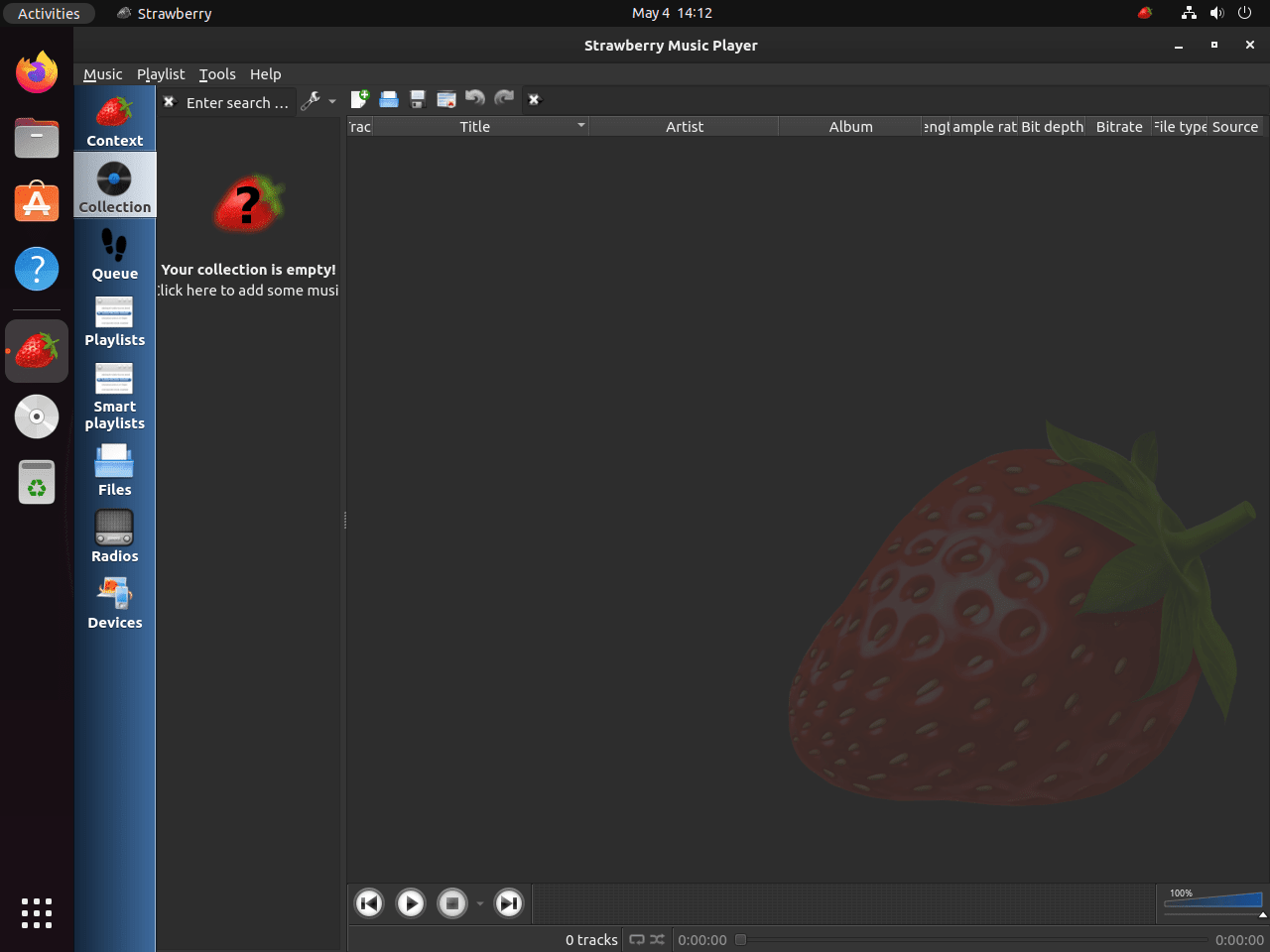
Strawberry is a desktop application, so launching it still requires a graphical session even if you installed it from a remote shell. Once you are back at the Ubuntu desktop, use the command or menu entry that matches your install method.
Launch Strawberry from the terminal on Ubuntu
APT installs use the regular launcher name.
strawberryFlatpak installs use the application ID through flatpak run.
flatpak run org.strawberrymusicplayer.strawberryLaunch Strawberry from the applications menu on Ubuntu
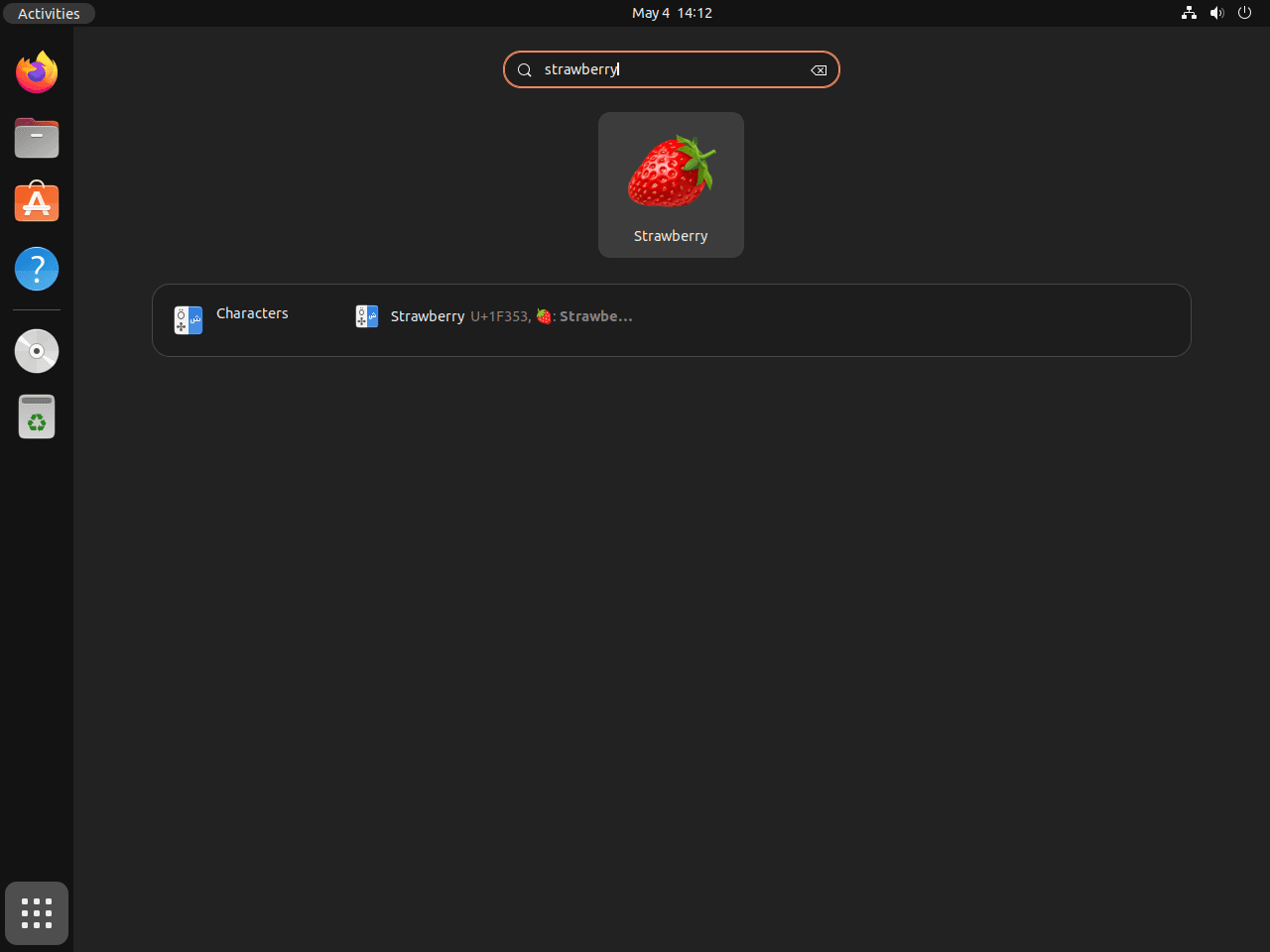
The desktop entry appears as Strawberry in the application grid for both APT and Flatpak installs.
- Open Activities.
- Select Show Applications.
- Search for Strawberry and launch it from the results.
Update or Remove Strawberry on Ubuntu
The update and removal path depends on whether Strawberry came from APT or Flatpak. Keep the package-manager cleanup and any optional source cleanup as separate steps so you can see what changed.
Update an APT-installed Strawberry package on Ubuntu
Use APT to refresh the package list, then upgrade only Strawberry without pulling unrelated packages.
sudo apt update && sudo apt install --only-upgrade strawberry -yUpdate the Strawberry Flatpak on Ubuntu
Use the same system scope you used during installation when you update the Flatpak build.
sudo flatpak update org.strawberrymusicplayer.strawberry -yRemove an APT-installed Strawberry package on Ubuntu
Remove the package and its orphaned dependencies first. This step is the same whether you installed Strawberry from Ubuntu’s repositories or from the PPA.
sudo apt remove --autoremove strawberry -yVerify that the package itself is gone before you clean up any optional repository source.
dpkg -s strawberry 2>/dev/null || echo "strawberry package not installed"strawberry package not installed
If you used the stable PPA, remove the source afterward and refresh APT so the candidate falls back to Ubuntu’s own repositories when they provide one.
sudo add-apt-repository --remove ppa:jonaski/strawberry -y && sudo apt updateConfirm the source cleanup with another policy check.
apt-cache policy strawberrystrawberry:
Installed: (none)
Candidate: 1.2.18-1
Version table:
1.2.18-1 500
500 http://archive.ubuntu.com/ubuntu resolute/universe amd64 Packages
After stable-PPA cleanup, Ubuntu 24.04 falls back to 1.0.23-1build3 from noble/universe. Ubuntu 22.04 shows Candidate: (none) because its default repositories still do not ship Strawberry.
Remove the Strawberry Flatpak on Ubuntu
Use Flatpak’s data-removal flag when you want to remove the app and its sandboxed profile in one step.
sudo flatpak remove --delete-data org.strawberrymusicplayer.strawberry -yCheck the installed-app list afterward instead of relying on flatpak info, which is less reliable after the app has already been removed.
flatpak list --app | grep -F org.strawberrymusicplayer.strawberry || echo "Flatpak app not installed"Flatpak app not installed
Strawberry may not create its user-data directories until you actually launch the desktop app, so do not delete config paths by guesswork. If you want a full cleanup, inspect
~/.config/strawberry,~/.cache/strawberry,~/.local/share/strawberry,~/.var/app/org.strawberrymusicplayer.strawberry, and~/.strawberry, then remove only the directories that actually exist.
Strawberry on Ubuntu FAQ
Ubuntu 24.04 froze on an older package set and ships strawberry 1.0.23-1build3 from noble/universe, while Ubuntu 26.04 ships 1.2.18-1 from resolute/universe. If you want the newer 1.2.x branch on Ubuntu 24.04, use the Strawberry PPA or the Flatpak build.
Use Ubuntu’s own package on 26.04 or 24.04 when you want the shortest APT workflow. Use the Strawberry PPA when you want the newest APT build or need Strawberry on Ubuntu 22.04, and use Flatpak when you want the same sandboxed release across every supported Ubuntu LTS.
Yes. The official Strawberry project describes Strawberry as a fork of Clementine, built in C++ with Qt and GStreamer, with a stronger focus on music collections, tag editing, and audio playback for large local libraries.
Usually yes, because the Flathub build is not tied to Ubuntu’s repository age. Flathub currently publishes Strawberry 1.2.18, which makes the Flatpak route the easiest way to keep Ubuntu 22.04 and 24.04 on the same release line as newer installs.
Strawberry on Ubuntu Conclusion
Strawberry is installed on Ubuntu and ready for local libraries, tag cleanup, and lossless playback. If you want better metadata hygiene next, install MusicBrainz Picard on Ubuntu. When the same collection also includes video files or network streams, install VLC Media Player on Ubuntu as well.

Formatting tips for your comment
You can use basic HTML to format your comment. Useful tags currently allowed in published comments:
<code>command</code>command<strong>bold</strong><em>italic</em><blockquote>quote</blockquote>