Browser-based readers are convenient until a service changes, a sync account disappears, or you simply want your subscriptions stored locally. Install Akregator on Ubuntu 26.04, 24.04, or 22.04 when you want a desktop RSS reader that keeps news sites, blogs, podcasts, and YouTube channels in one application with offline access and tight KDE integration.
Ubuntu users can install Akregator either from Ubuntu’s repository or from Flathub. The repository gives you the distro-packaged build with standard system updates, while Flatpak uses KDE’s verified Flathub record and keeps app/runtime updates separate from Ubuntu packages. Akregator installs from a terminal on all three supported Ubuntu LTS releases, but it still needs an active graphical session to launch.
Install Akregator on Ubuntu
Choose the repository build if you want the version that matches your Ubuntu release, or use Flatpak if you want KDE’s verified Flathub record and per-app Flatpak updates.
| Method | Source | Channel | Updates | Best Fit |
|---|---|---|---|---|
| APT repository | Ubuntu universe | Distribution default | apt upgrades | Smaller dependency set and tighter Ubuntu integration |
| Flatpak | Flathub | Store stable channel | flatpak update | Desktop users who prefer KDE’s Flathub package outside the Ubuntu release cadence |
Ubuntu 26.04, 24.04, and 22.04 all provide an APT package for Akregator. The Flatpak method also works across these releases. Minimal systems can complete the install commands, but Akregator is still a desktop application and needs a graphical session to open.
Update Ubuntu Before Installing Akregator
Refresh the package index and install pending upgrades first so Akregator pulls against current repository metadata.
sudo apt update
sudo apt upgrade -y
These commands use
sudofor tasks that need administrator privileges. If your account does not have sudo access yet, follow the guide on how to add a new user to sudoers on Ubuntu.
Install Akregator from Ubuntu Repository
The Ubuntu package is the best fit if you want Akregator to track your release’s KDE libraries and update with the rest of the system.
Akregator is in Ubuntu’s
universecomponent. If APT cannot locate the package on a customized system, enable Universe on Ubuntu, refresh the package index, and then retry the install command.
sudo apt install akregator -yFor a headless-safe verification, query the installed package state instead of running the GUI binary from SSH or a text console.
dpkg-query -W -f='${db:Status-Abbrev} ${binary:Package} ${Version}\n' akregatorii akregator 4:25.12.3-0ubuntu1
Check the package source when you need to confirm the release candidate and archive component.
apt-cache policy akregatorakregator:
Installed: 4:25.12.3-0ubuntu1
Candidate: 4:25.12.3-0ubuntu1
Version table:
*** 4:25.12.3-0ubuntu1 500
500 http://au.archive.ubuntu.com/ubuntu resolute/universe amd64 Packages
100 /var/lib/dpkg/status
Ubuntu 24.04 reports 4:23.08.5-0ubuntu4.1 after installation, and Ubuntu 22.04 reports 4:21.12.3-0ubuntu1. The install still creates the same akregator terminal launcher and org.kde.akregator.desktop application-menu entry on each release.
Install Akregator with Flatpak on Ubuntu
Use Flatpak when you prefer a Flathub-managed app and KDE Platform runtime outside Ubuntu’s package cadence.
If the
flatpakcommand is missing on your system, follow the guide to install Flatpak on Ubuntu before continuing.
Add the Flathub remote first. The --if-not-exists flag prevents duplicate-remote errors if you rerun the command later.
sudo flatpak remote-add --if-not-exists flathub https://dl.flathub.org/repo/flathub.flatpakrepoConfirm that Flathub is available at system scope before you install the application.
flatpak remotes --columns=name,options | awk '$1 == "flathub" {print $1, $2}'flathub system
Install Akregator from Flathub:
sudo flatpak install flathub org.kde.akregator -yVerify the Flatpak package metadata after installation.
flatpak info org.kde.akregatorAkregator - Keep up with your feeds
ID: org.kde.akregator
Ref: app/org.kde.akregator/x86_64/stable
Arch: x86_64
Branch: stable
Version: 6.6.2
Origin: flathub
Installation: system
Akregator’s Flatpak metadata uses KDE’s 6.x application version line, while Ubuntu’s package string uses a KDE Gear-style 25.x package version on current releases. Treat those strings as source labels rather than a simple newer-versus-older comparison.
Launch Akregator on Ubuntu
Akregator launches from the application menu on GNOME and other Ubuntu desktops once a graphical login is active. KDE Plasma is not required, but install KDE Plasma on Ubuntu if you want tighter integration with Kontact, KDE wallet prompts, and KDE widgets.
Launch Repository-installed Akregator on Ubuntu
Use the package-provided launcher from a terminal emulator inside your desktop session.
akregatorLaunch Flatpak-installed Akregator on Ubuntu
Use the Flatpak runtime command if you installed Akregator from Flathub.
flatpak run org.kde.akregatorLaunch Akregator from Ubuntu’s Application Menu
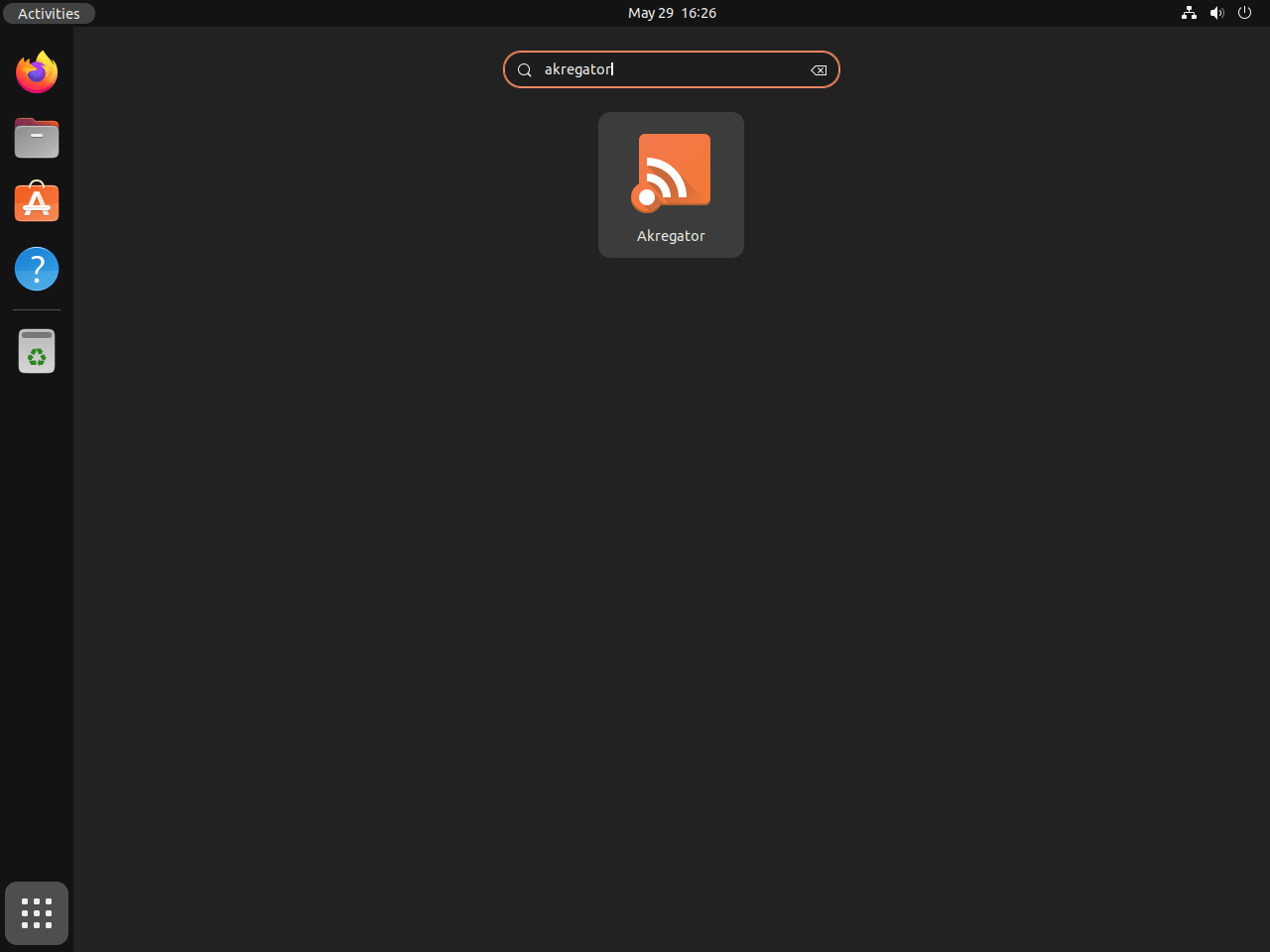
Open your desktop’s application menu, search for Akregator, and start it like any other GUI application.
Add RSS Feeds to Akregator on Ubuntu
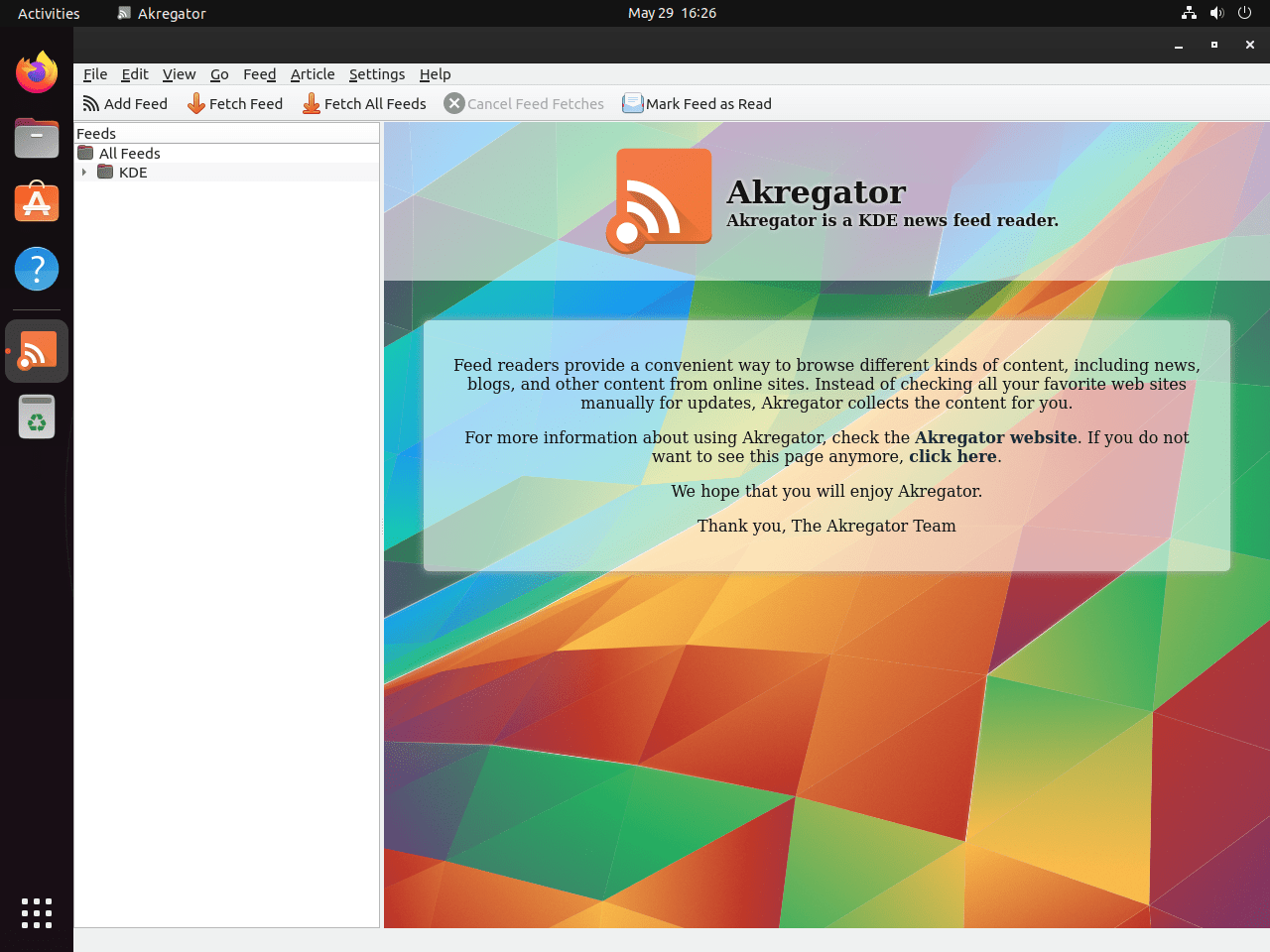
After Akregator opens, add subscriptions from Feed > Add Feed, then use File > Import Feeds or File > Export Feeds when you want to move OPML subscriptions between readers or keep a backup.
Akregator on Ubuntu can subscribe to standard RSS and Atom URLs, including YouTube channel feeds that use the https://www.youtube.com/feeds/videos.xml?channel_id=CHANNEL_ID format.
- News sites often publish feeds like
https://example.com/tech/rssorhttps://example.com/news/feed. - Blogs commonly use patterns such as
https://blog.example.com/feedorhttps://example.com/rss.xml. - YouTube channels use
https://www.youtube.com/feeds/videos.xml?channel_id=CHANNEL_ID.
Update or Remove Akregator on Ubuntu
Update Repository-installed Akregator on Ubuntu
Use APT when you installed the Ubuntu package.
sudo apt update
sudo apt install --only-upgrade akregator -y
Update Flatpak Akregator on Ubuntu
Update only the Akregator Flatpak when you want to leave other Flatpak applications alone.
sudo flatpak update org.kde.akregator -yRemove Repository-installed Akregator on Ubuntu
Use the Ubuntu package manager to remove Akregator first.
sudo apt remove akregator -yPreview dependency cleanup before removing libraries, because reused desktops can have unrelated packages in the autoremovable set.
sudo apt autoremove --dry-runIf the preview only lists packages you no longer need, run the cleanup interactively.
sudo apt autoremoveConfirm that the Ubuntu package is no longer installed.
dpkg-query -W -f='${db:Status-Abbrev} ${binary:Package}\n' akregator 2>/dev/null | grep '^ii' || echo not-installednot-installed
Removing the package does not back up your personal feeds for you. Export an OPML copy from Akregator before uninstalling if you want to keep your subscription list for another system or reader.
Remove Flatpak Akregator on Ubuntu
Remove the system-scope Flatpak package with the same scope used during installation.
sudo flatpak remove org.kde.akregator -yVerify that the Flatpak application is gone.
flatpak list --app --columns=application | grep -Fx org.kde.akregator || echo not-installednot-installed
Flatpak application data lives in your home directory, separate from the system-scope app package.
Export your feeds to OPML before deleting the Flatpak profile if you want to keep your subscription list.
rm -rf ~/.var/app/org.kde.akregator
test ! -d ~/.var/app/org.kde.akregator && echo profile-removed
profile-removed
Troubleshoot Akregator on Ubuntu
The most common Akregator issue on Ubuntu is trying to launch it from a shell that has no graphical display attached.
Fix Akregator Launch Failures Without a Graphical Session on Ubuntu
If you start Akregator from SSH or a text-only console, Qt cannot connect to the desktop display and the application aborts with errors like these:
qt.qpa.xcb: could not connect to display
Could not load the Qt platform plugin "xcb"
Check whether the shell can see a graphical session:
printf 'DISPLAY=%s\nWAYLAND_DISPLAY=%s\n' "${DISPLAY:-unset}" "${WAYLAND_DISPLAY:-unset}"DISPLAY=unset WAYLAND_DISPLAY=unset
If both values are unset, return to a local desktop session, then launch Akregator from the Ubuntu application menu or from a terminal emulator inside GNOME or KDE Plasma.
Conclusion
Akregator is ready on Ubuntu for RSS, Atom, OPML imports, and local feed reading without relying on a web service. Keep the APT build when release-matched KDE libraries matter most, or use the Flathub package when you prefer separate Flatpak app and runtime updates.


Formatting tips for your comment
You can use basic HTML to format your comment. Useful tags currently allowed in published comments:
<code>command</code>command<strong>bold</strong><em>italic</em><a href="https://example.com">link</a><blockquote>quote</blockquote>