
Calibre is a free, open-source e-book management application for Linux that handles EPUB, MOBI, and PDF collections, converts formats for Kindle and Kobo e-readers, and shares your library across devices through a built-in content server. Three methods are available to install Calibre on Ubuntu, ranging from the stable APT repository package to third-party sources with newer upstream releases.
Install Calibre on Ubuntu
The table below compares the three Calibre installation methods on Ubuntu:
| Method | Channel | Version | Updates | Best For |
|---|---|---|---|---|
| Ubuntu Repository (APT) | Ubuntu Repos | Distribution default | Via apt upgrade | Users who prefer distro-tested stability |
| Xtradeb PPA | Launchpad PPA | Latest stable | Via apt upgrade | Users wanting newer features without Flatpak |
| Flatpak | Flathub | Latest stable | Via flatpak update | Users who want sandboxing and newest releases |
For most users, the Ubuntu repository method is recommended because it provides automatic security updates and requires no additional configuration. Choose the Xtradeb PPA if you specifically need newer Calibre features that haven’t reached Ubuntu’s repositories yet, or Flatpak if you prefer sandboxed applications with the latest upstream releases.
This guide covers Ubuntu 26.04 LTS, 24.04 LTS, and 22.04 LTS. The Xtradeb PPA does not provide Calibre packages for every release; if packages are unavailable for your version, use the Flatpak method instead.
Default Calibre versions vary significantly across Ubuntu releases:
| Ubuntu Release | APT Default | Xtradeb PPA | Flatpak (Flathub) |
|---|---|---|---|
| 26.04 LTS (Resolute) | 8.16.x | Not available | 9.2.x |
| 24.04 LTS (Noble) | 7.6.x | 8.7.x | 9.2.x |
| 22.04 LTS (Jammy) | 5.37.x | 6.29.x | 9.2.x |
Method 1: Install Calibre via Ubuntu Repository (APT)
This method installs Calibre directly from Ubuntu’s official repositories, providing a stable version that integrates well with your system. As a result, you receive security updates automatically through the standard package management process.
Update the Package Index
Before installing any software, refresh your package lists to ensure you’re working with the latest available versions:
sudo apt update && sudo apt upgradeThis command first updates the package index and then upgrades any outdated packages on your system, avoiding potential dependency conflicts during installation.
This guide uses
sudofor commands that need root privileges. If your user is not in the sudoers file yet, run the commands as root or follow the guide on how to add and manage sudo users on Ubuntu.
Install Calibre from Ubuntu Repository
Once your system is up-to-date, install Calibre with APT:
sudo apt install calibreAPT fetches Calibre and all required dependencies from Ubuntu’s universe repository.
Verify the Installation
After installation completes, confirm that Calibre is accessible by checking its version:
calibre --versionYou should see output similar to:
calibre (calibre 8.16.x)
The exact version depends on your Ubuntu release; check the version comparison table above for per-release details. If you need newer features, the Xtradeb PPA or Flatpak methods below provide more recent releases.
Method 2: Install Calibre via Xtradeb PPA
Alternatively, the Xtradeb PPA provides more recent Calibre versions than Ubuntu’s default repositories. This method is particularly useful when you need specific features from newer releases while still using APT for package management.
The Xtradeb PPA provides Calibre packages for Ubuntu 24.04 LTS and 22.04 LTS. Ubuntu 26.04 LTS is not supported by this PPA because no Calibre builds are available for that release. If you run 26.04, use the Flatpak method instead.
Add the Xtradeb PPA Repository
Add the Xtradeb PPA to your system’s software sources:
sudo add-apt-repository ppa:xtradeb/apps -yThis command imports the PPA’s GPG key and then adds the repository to your APT sources. Additionally, the -y flag automatically confirms the addition without prompting.
Configure APT Pinning (Recommended)
Because the Xtradeb PPA contains many applications beyond Calibre, you should configure APT pinning. This prevents APT from unexpectedly installing or upgrading other packages from this PPA, ensuring only Calibre-related packages are prioritized:
cat <<EOF | sudo tee /etc/apt/preferences.d/calibre-pin
Package: *
Pin: release o=LP-PPA-xtradeb-apps
Pin-Priority: 100

Package: calibre*
Pin: release o=LP-PPA-xtradeb-apps
Pin-Priority: 700
EOF
This configuration works in two stages: first, the initial rule lowers all PPA packages to priority 100 (below the default 500), and then the second rule raises Calibre packages specifically to priority 700. As a result, APT prefers Calibre from the PPA while ignoring other PPA packages.
Update and Install Calibre
After adding the PPA, refresh your package lists to include the new repository:
sudo apt updateVerify that APT recognizes the PPA version by checking the package policy:
apt-cache policy calibreYou should see output showing the PPA version with higher priority:
calibre:
  Installed: (none)
  Candidate: 8.7.0+ds-1xtradeb1.2404.1
  Version table:
     8.7.0+ds-1xtradeb1.2404.1 700
        100 https://ppa.launchpadcontent.net/xtradeb/apps/ubuntu noble/main amd64 Packages
     7.6.0+ds-1build1 500
        500 http://archive.ubuntu.com/ubuntu noble/universe amd64 Packages
Install Calibre from the PPA:
sudo apt install calibreIf you already have Calibre installed from Ubuntu’s repository, this command will upgrade it to the PPA version.
Verify the PPA Installation
To confirm the installation succeeded, check which version is now installed:
calibre --versionThe output should show the newer PPA version:
calibre (calibre 8.7.x)
Method 3: Install Calibre via Flatpak
Alternatively, Flatpak provides Calibre in a sandboxed environment with access to the latest upstream releases. Because this method works across all Ubuntu versions, it is ideal for releases not supported by the Xtradeb PPA.
Flatpak is not pre-installed on Ubuntu. If you have not set it up yet, install it with
sudo apt install flatpakand restart your session before continuing. For detailed setup including the Flathub repository, follow our Flatpak installation guide for Ubuntu.
Enable the Flathub Repository
If you haven’t already added Flathub to your system, add it now:
sudo flatpak remote-add --system --if-not-exists flathub https://flathub.org/repo/flathub.flatpakrepoThe --if-not-exists flag ensures the command succeeds even if Flathub is already configured.
Install Calibre from Flathub
Install Calibre using Flatpak:
sudo flatpak install --system flathub com.calibre_ebook.calibre -yFlatpak downloads Calibre and any required runtime dependencies. The first Flatpak installation takes longer because it also downloads shared runtime components.
Verify the Flatpak Installation
Confirm that Calibre is installed and accessible:
flatpak list | grep -i calibreYou should see output similar to:
calibre com.calibre_ebook.calibre 9.2.x stable system
Launch Calibre on Ubuntu
Once installed, you can start Calibre using either the terminal or your desktop environment’s application launcher.
Launch from Terminal
For APT installations (repository or PPA), launch Calibre directly:
calibreAlternatively, for Flatpak installations, use the Flatpak run command instead:
flatpak run com.calibre_ebook.calibreLaunch from Applications Menu
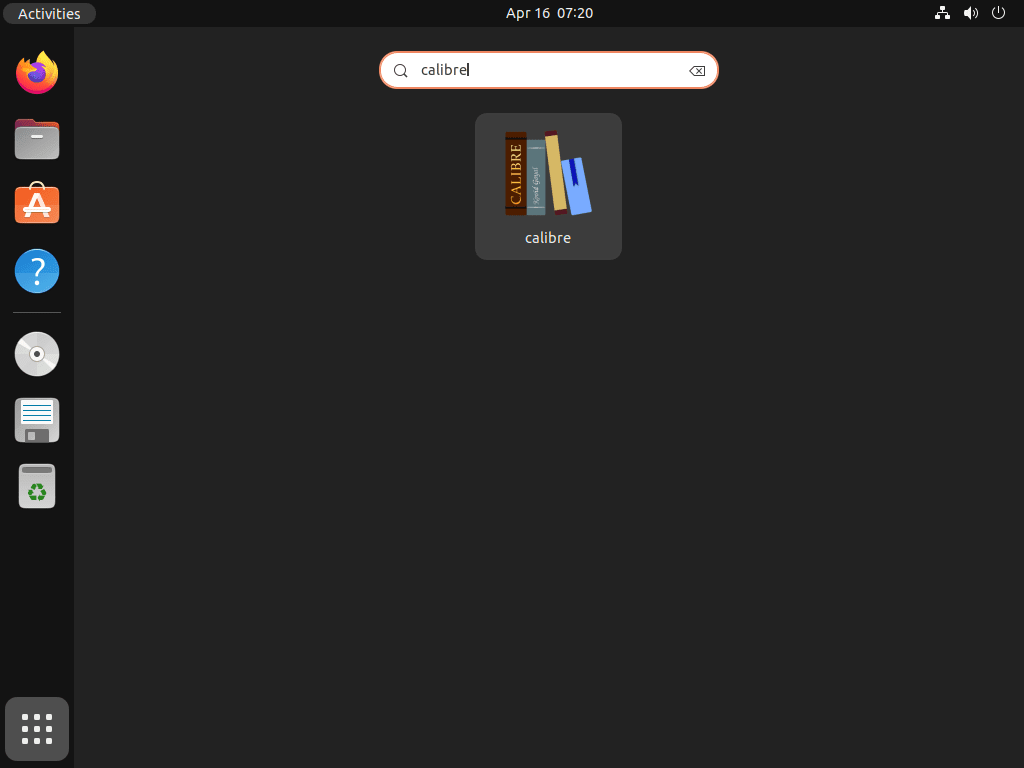
On GNOME (Ubuntu’s default desktop), open the Activities overview by clicking “Activities” in the top-left corner. Type “Calibre” in the search bar and click the Calibre icon when it appears. You can also find it in the “Show Applications” grid.
Complete the Calibre Setup Wizard on Ubuntu
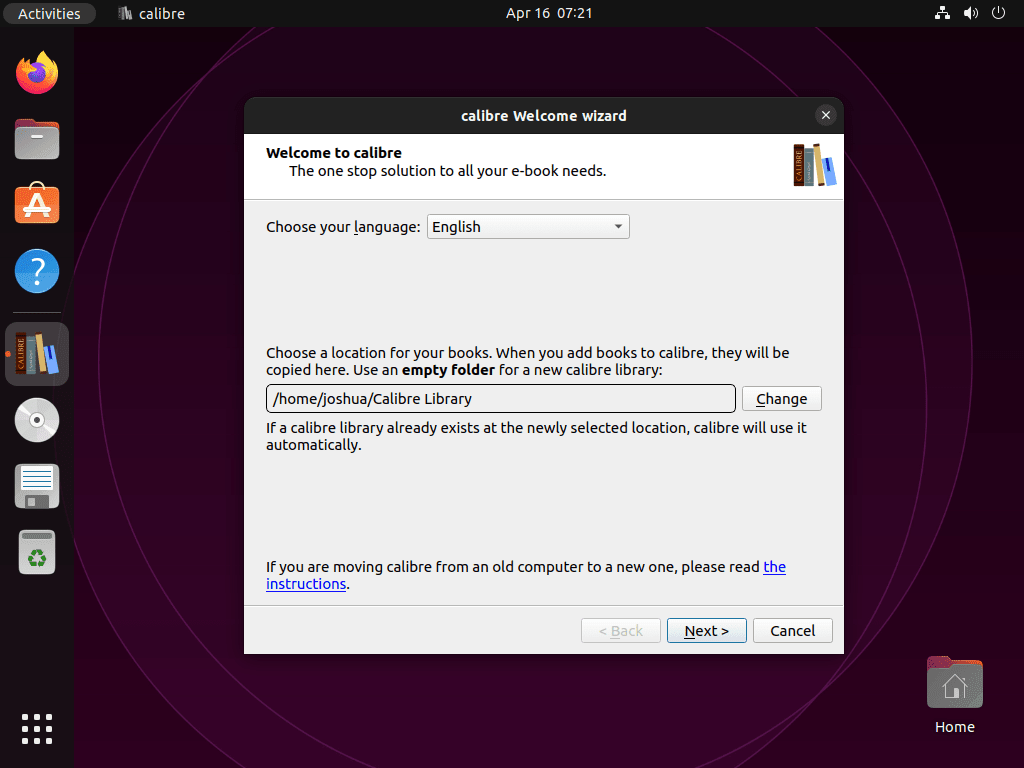
When you first launch Calibre, a setup wizard helps you configure essential settings.
Set Your Library Location
The wizard first asks where to store your Calibre library. The default location is ~/Calibre Library in your home directory. You can keep this default or click “Change” to select a different location. If you have an existing Calibre library from another computer, point to that folder instead.
Click “Next” to continue.
Select Your E-Reader Device
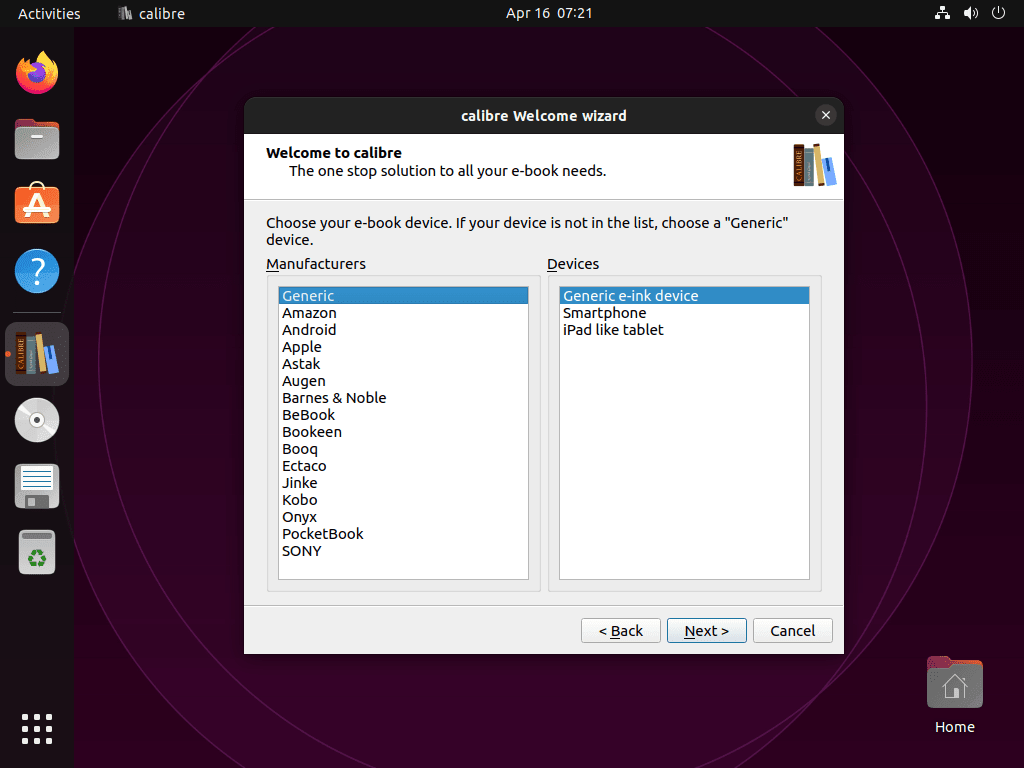
Next, select your primary e-reader device. This setting optimizes format conversion for your specific device. However, if you don’t have a dedicated e-reader or use multiple devices, select “Generic” instead to maintain maximum compatibility.
Click “Next” to continue.
Finish the Setup
Finally, click “Finish” on the final screen to complete the wizard and open the main Calibre interface. From here, you can import e-books by dragging files onto the window or by using the “Add books” button in the toolbar.
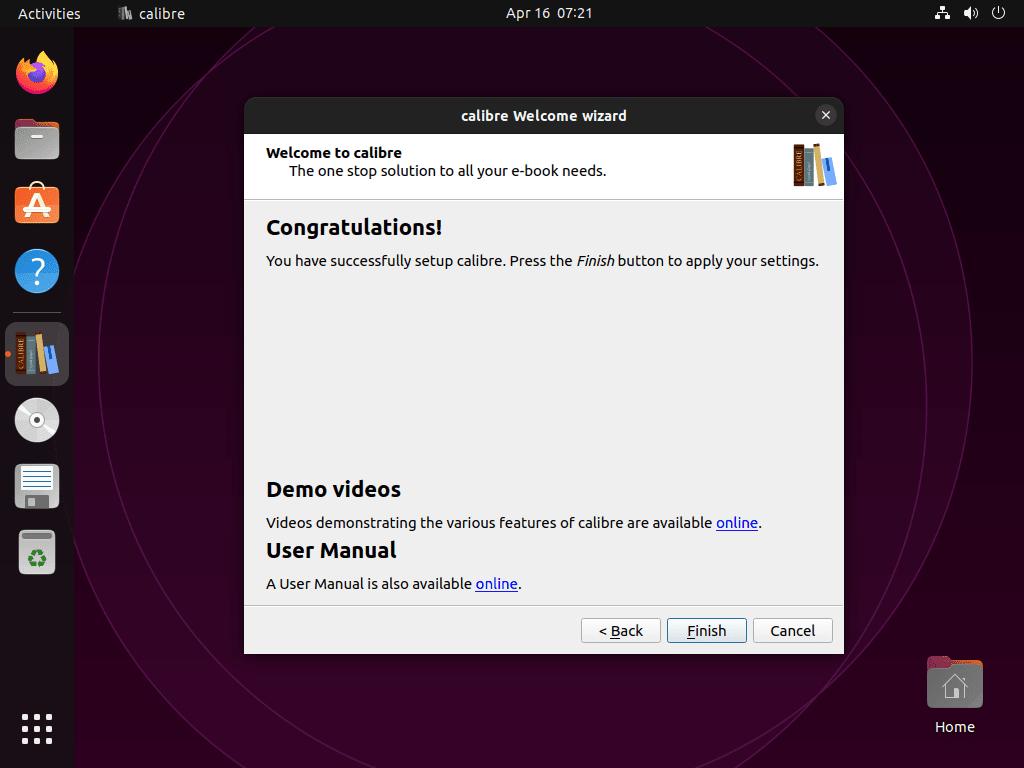
Explore the Main Interface
After completing the wizard, the main Calibre window displays your library (initially empty). From here, the toolbar provides quick access to common tasks: adding books, editing metadata, converting formats, and sending books to connected devices. Additionally, the sidebar lets you filter your library by author, series, tags, or other metadata fields.
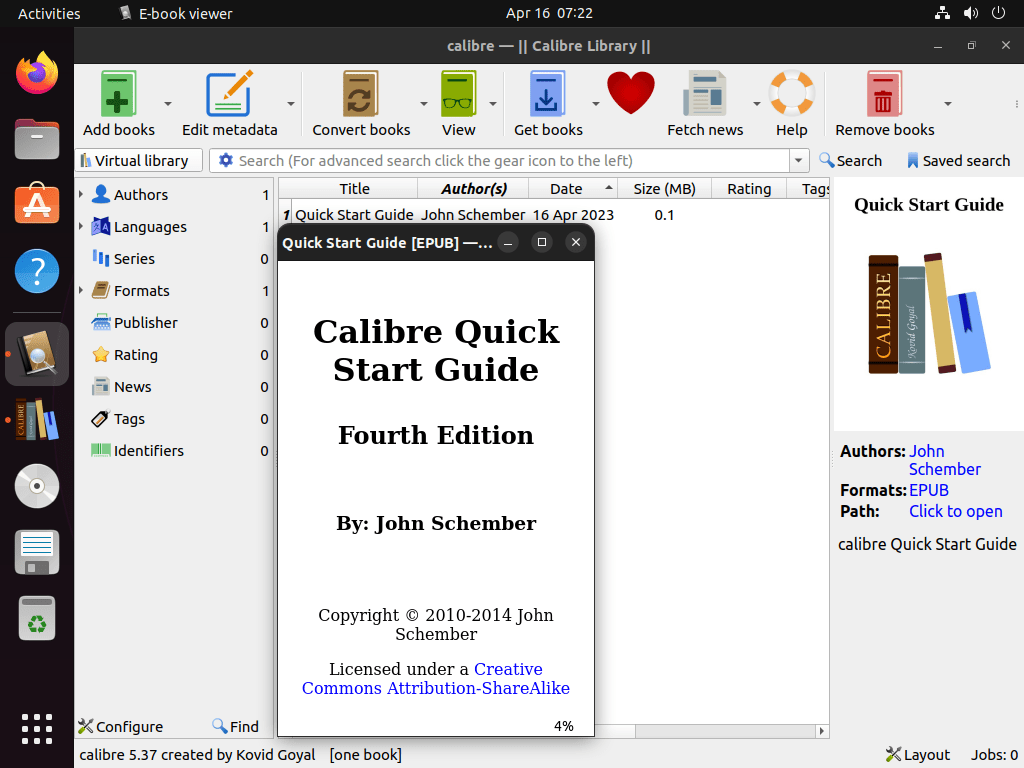
Manage Calibre on Ubuntu
Update Calibre
Keeping Calibre updated ensures you have the latest features, format support, and security fixes.
APT installations (repository or PPA):
sudo apt update && sudo apt upgradeThis command updates all packages on your system. As a result, Calibre will be upgraded if a new version is available.
Flatpak installations:
sudo flatpak update --systemAfter updating, you can verify the new version with calibre --version (APT) or by checking the Flatpak list.
Remove Calibre
If you no longer need Calibre, follow the removal steps corresponding to your installation method.
Remove APT Installation (Repository)
To remove Calibre, run these commands to uninstall the package and clean up orphaned dependencies:
sudo apt remove --purge calibre
sudo apt autoremove
Here, the autoremove command removes dependencies that were installed alongside Calibre but are no longer needed by other packages.
Remove APT Installation (PPA)
First remove Calibre, then remove the PPA and clean up:
sudo apt remove --purge calibre
sudo apt autoremove
sudo add-apt-repository --remove ppa:xtradeb/apps -y
sudo rm -f /etc/apt/preferences.d/calibre-pin
sudo apt update
In sequence, these commands remove Calibre, clean up orphaned packages, remove the PPA repository, delete the APT pinning configuration, and finally refresh your package cache.
Remove Flatpak Installation
To uninstall Calibre and its sandboxed data, run:
sudo flatpak uninstall --system --delete-data com.calibre_ebook.calibreHere, the --delete-data flag removes application data stored within the Flatpak sandbox at ~/.var/app/com.calibre_ebook.calibre/.
Remove User Library Data (Optional)
The following command permanently deletes your Calibre library, including all imported e-books, metadata, and cover images. If you want to keep your library, skip this step or back it up first with
cp -r ~/Calibre\ Library ~/calibre-backup.
To completely remove your Calibre library and configuration files, run:
rm -rf ~/Calibre\ Library
rm -rf ~/.config/calibre
Note that the first command removes the default library location. However, if you chose a custom library location during setup, remove that directory instead.
Troubleshoot Calibre on Ubuntu
calibre: command not found After Flatpak Install
Flatpak applications do not add commands to your shell PATH. Launch Calibre through the Flatpak wrapper instead:
flatpak run com.calibre_ebook.calibreIf the desktop icon also fails to appear, log out and back in so your desktop environment picks up the new .desktop file.
PPA Version Not Selected After Adding Xtradeb PPA
If apt-cache policy calibre still shows the Ubuntu repository version as the candidate, verify that the pin file exists and contains the correct origin:
cat /etc/apt/preferences.d/calibre-pinConfirm the output matches the pinning configuration from the PPA section above. Then refresh the package index and recheck:
sudo apt update && apt-cache policy calibreThe PPA version should now appear with priority 700, above the default 500.
Calibre Fails to Import or Convert E-Books
Missing format plugins or outdated conversion libraries can cause import failures. First verify your Calibre version is current using the update commands in the management section above. If the issue persists, check file permissions on your library directory:
ls -ld ~/Calibre\ LibraryThe directory should be owned by your user. If ownership is incorrect, fix it with:
sudo chown -R "$USER":"$USER" ~/Calibre\ LibraryCalibre Official Resources
For additional information about Calibre on Ubuntu, consult these official resources:
- Calibre Official Website: Download options, feature overview, and project news.
- Calibre User Manual: Comprehensive documentation covering all features and configuration options.
- Calibre Community Forum: User discussions, troubleshooting help, and plugin recommendations.
Frequently Asked Questions
Yes. Calibre fully supports Linux, including Ubuntu. You can install it from the default Ubuntu repositories, a third-party PPA for newer versions, or Flatpak for the latest upstream release with sandboxing.
The default version depends on your Ubuntu release. Ubuntu 26.04 LTS ships Calibre 8.16.x, Ubuntu 24.04 LTS includes Calibre 7.6.x, and Ubuntu 22.04 LTS provides Calibre 5.37.x. For a newer version, use the Xtradeb PPA or install Calibre via Flatpak.
No. The Xtradeb PPA provides Calibre packages for Ubuntu 24.04 LTS and 22.04 LTS. Ubuntu 26.04 LTS does not have Calibre builds available in this PPA. If your release is unsupported, install Calibre via Flatpak instead.
Conclusion
Calibre is now running on Ubuntu with your chosen installation method, ready to import e-books, convert between EPUB, MOBI, and PDF formats, sync with Kindle or Kobo devices, and share your collection through the content server. Regular updates through APT or Flatpak keep format support and security fixes current, and the Flatpak setup guide for Ubuntu covers additional sandboxed application options alongside Calibre.

Formatting tips for your comment
You can use basic HTML to format your comment. Useful tags currently allowed:
<code>command</code>command<strong>bold</strong><em>italic</em><blockquote>quote</blockquote>