Linux command examples - Page 6
Find practical command examples with flags, expected output, common mistakes, and safer ways to run everyday shell workflows.
Curated guides
Linux command guides
80 matched guides, best match first. Page 6 of 7.
printf Command in Linux with Examples
Shell output gets messy once a script needs aligned columns, padded counters, literal percent signs, or data with embedded escape sequences. The printf command in Linux gives you...

whereis Command in Linux with Examples
When a command exists in more than one place, or its documentation seems missing, the whereis command in Linux gives you a quick inventory of the binary, source,...

read Command in Linux with Examples
Interactive shell scripts need a clean way to pause, collect an answer, and reuse that value in the next command. The read command in Linux handles that job...

ifconfig Command in Linux with Examples
Legacy network notes still tell admins to run the ifconfig command in Linux, especially on older servers, embedded images, and scripts written before iproute2 became standard. ifconfig reads...
wget Command in Linux with Examples
Large downloads, flaky SSH sessions, and offline documentation mirrors are where the wget command earns its keep. It retrieves files over HTTP, HTTPS, FTP, and FTPS without a...

tail Command in Linux with Examples
Large logs are awkward to open in an editor when the only lines you care about are the newest ones. The tail command in Linux solves that problem...

ssh Command in Linux with Examples
Remote administration depends on SSH because login sessions, one-off commands, and encrypted tunnels all travel through the same client without exposing plaintext credentials. The ssh command in Linux...

du Command in Linux (With Examples)
When a filesystem starts filling up, the du command in Linux tells you which directories and files are actually consuming space. It is useful for checking log growth,...

split Command in Linux with Examples
Large logs, database exports, and backup archives get easier to move or process when you can cut them into predictable pieces without changing the original data. The split...
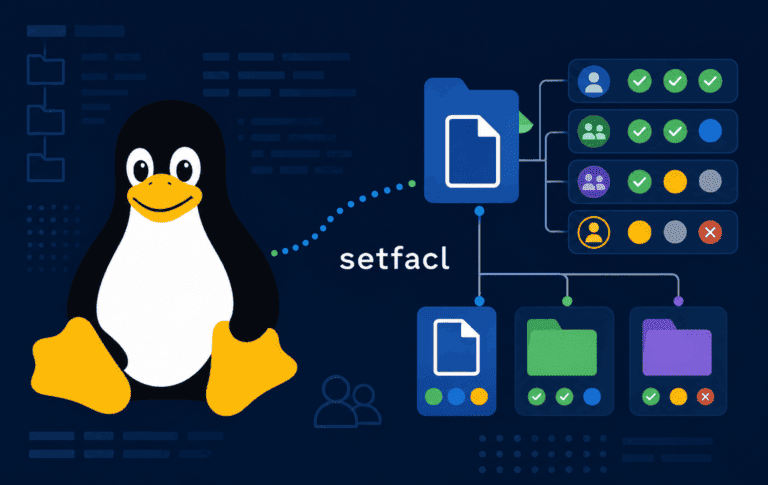
setfacl Command in Linux: ACL Permissions Examples
Shared directories get awkward when owner, group, and other permission bits are too blunt. The setfacl command in Linux lets you grant a specific user or group access...
nslookup Command in Linux with Examples
When a domain points to the wrong address or email delivery starts failing, the nslookup command in Linux gives you a fast way to ask DNS what it...

mkdir Command in Linux with Examples
Directory setup gets repetitive fast when projects, logs, uploads, and backups all need predictable paths. The mkdir command in Linux creates those directories from the shell, whether you...