DeSmuME remains useful on an Ubuntu Linux desktop when you want a focused Nintendo DS emulator instead of a full multi-system frontend. To install DeSmuME on Ubuntu, choose between Ubuntu’s universe package and the Flathub build. The launch path then depends on the package source and Ubuntu release.
The release split matters. Ubuntu 26.04 and 24.04 package only the command-line frontend, while Ubuntu 22.04 still includes GTK launchers. Flathub keeps the graphical app available on all three releases. It is unverified and currently uses DeSmuME 0.9.11, so treat it as a GUI convenience choice rather than a newer upstream build.
Install DeSmuME on Ubuntu
Choose the DeSmuME Installation Method on Ubuntu
APT is the cleaner package-manager path because it comes from Ubuntu’s own archive and updates with the rest of the system. Flatpak is the practical GUI path on Ubuntu 26.04 and 24.04 because those APT packages install only desmume-cli.
If you searched for a direct DeSmuME Linux download, the official DeSmuME download page currently points to the 0.9.13 GitHub release. That release includes a Linux source archive, not a ready-made Ubuntu .deb or AppImage, so the managed APT and Flatpak paths are better fits for normal desktop installs.
Stick to known sources: Ubuntu’s archive, the Flathub app page, or the official DeSmuME site and GitHub release. Avoid random emulator download mirrors, ROM bundles, or third-party installers that mix the emulator with game files.
| Method | Source | Ubuntu Release Behavior | Update Path | Best Fit |
|---|---|---|---|---|
| APT package | Ubuntu universe | 26.04: 0.9.13 CLI only; 24.04: 0.9.11 CLI only; 22.04: 0.9.11 GTK and CLI | With normal APT upgrades | Users who prefer Ubuntu-packaged software or the newer 26.04 CLI build |
| Flatpak | Flathub | 0.9.11 stable, graphical app, x86_64 and aarch64 builds | With Flatpak app and runtime updates | Users who need the graphical launcher on Ubuntu 26.04 or 24.04 |
Ubuntu 26.04 LTS, 24.04 LTS, and 22.04 LTS are covered here. The APT package changes by release, so do not expect the same launcher or package version on every supported Ubuntu system.
Update Ubuntu Before Installing DeSmuME
Refresh the package index before installing the APT package or Flatpak prerequisites. If Ubuntu lists pending upgrades, review them before applying them so unrelated system changes do not get mixed into the emulator install.
sudo apt updateInstall DeSmuME with APT
Ubuntu provides DeSmuME from the universe component. Standard desktop installs usually already have universe enabled, but minimal or customized systems may need it enabled first if APT cannot locate the package.
sudo apt install desmumeIf Ubuntu returns E: Unable to locate package desmume, enable the repository component with the guide to enable Universe and Multiverse on Ubuntu, then rerun sudo apt update.
Verify the APT DeSmuME Package
Confirm the package state and installed version with dpkg-query:
dpkg-query -W -f='${db:Status-Abbrev} ${binary:Package} ${Version}\n' desmumeOn Ubuntu 26.04, the installed package currently reports:
ii desmume 0.9.13-4build1
Ubuntu 24.04 reports 0.9.11-7build2, while Ubuntu 22.04 reports 0.9.11-3build2. The installed binary set also differs: 26.04 and 24.04 provide /usr/games/desmume-cli only, while 22.04 also provides /usr/games/desmume, /usr/games/desmume-glade, and desktop launcher files.
Install DeSmuME with Flatpak
Use the Flatpak method when you want the graphical DeSmuME interface on Ubuntu 26.04 or 24.04. Flathub currently marks this app as unverified and potentially unsafe, and the current manifest requests broad device access. That permission can matter for input hardware such as controllers, but it makes Flatpak a packaging tradeoff rather than a stronger isolation choice.
Flatpak is not pre-installed on Ubuntu. If you have not set it up yet, install it with
sudo apt install flatpakand restart your session before continuing. For detailed setup including the Flathub repository, follow the guide to install Flatpak on Ubuntu.
Add Flathub for DeSmuME
Add the Flathub remote if your Ubuntu system does not already have it. The --if-not-exists flag keeps the command repeat-safe when Flathub is already configured.
sudo flatpak remote-add --if-not-exists flathub https://dl.flathub.org/repo/flathub.flatpakrepoInstall the DeSmuME Flatpak
Install the Flathub app ID with Flatpak:
sudo flatpak install flathub org.desmume.DeSmuME -yVerify the installed Flatpak reference:
flatpak info --show-ref org.desmume.DeSmuMEOn a typical 64-bit PC, the stable app returns:
app/org.desmume.DeSmuME/x86_64/stable
Launch DeSmuME on Ubuntu
DeSmuME launch behavior depends on the package source. Flatpak and the Ubuntu 22.04 APT package create graphical launchers, while Ubuntu 26.04 and 24.04 APT installs use the terminal-only desmume-cli frontend.
Launch from the Applications Menu
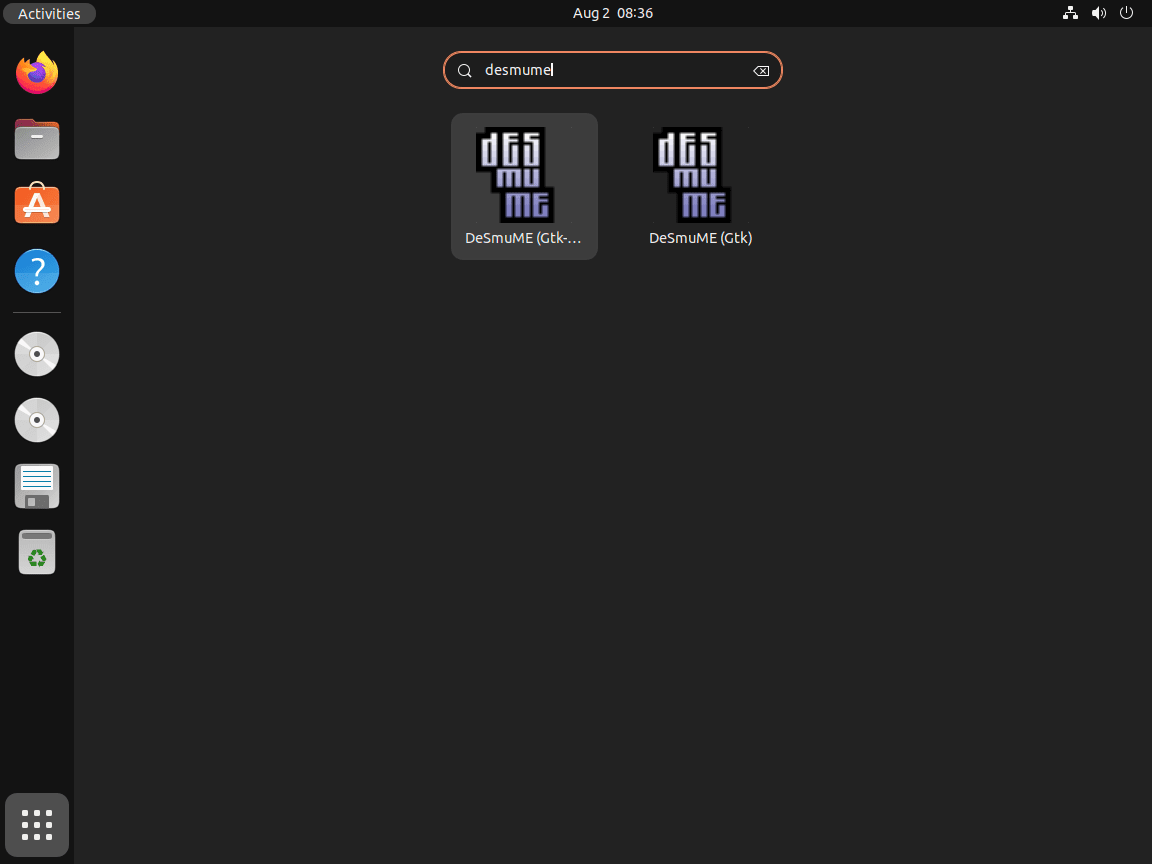
For Flatpak installs, open Activities, search for DeSmuME, and select the DeSmuME launcher. Ubuntu 22.04 APT installs can show two launchers, DeSmuME (Gtk) and DeSmuME (Gtk-Glade), because that older package still includes both GTK frontends.
Launch from the Terminal
Run the Flatpak build with its app ID:
flatpak run org.desmume.DeSmuMEUbuntu 26.04 and 24.04 APT installs require a ROM path because they provide only desmume-cli:
desmume-cli /path/to/your-game.ndsIf your shell does not include /usr/games in $PATH, use the full binary path:
/usr/games/desmume-cli /path/to/your-game.ndsUbuntu 22.04 APT users can start the GTK frontend without a ROM argument:
desmumeThe alternate GTK-Glade frontend is also available on Ubuntu 22.04:
desmume-gladeOpen ROMs and Configure Controls
In the graphical app, open Nintendo DS ROM files from the File menu, then adjust keyboard or controller mappings from the Config menu. Use ROMs you own or are otherwise allowed to run; DeSmuME is the emulator, not a source for game files.
Save states are convenient for quick pauses, but normal in-game saves are more durable across emulator changes. Native DeSmuME stores its profile under ~/.config/desmume, while the Flatpak profile stays under ~/.var/app/org.desmume.DeSmuME. If you rely on long-running saves, back up the matching profile directory before deleting profile data or switching package sources.
Update or Remove DeSmuME on Ubuntu
Update DeSmuME
APT installs update through Ubuntu’s package sources. Use --only-upgrade so APT upgrades DeSmuME only when the package is already installed.
sudo apt update
sudo apt install --only-upgrade desmume
Flatpak installs update through Flathub:
sudo flatpak update org.desmume.DeSmuME -yRemove the APT Package
Remove the Ubuntu package with APT:
sudo apt remove desmumeConfirm that the installed package row is gone:
dpkg -l desmume | grep '^ii' || echo "desmume not installed"desmume not installed
If APT lists unused dependencies after removal, review them before deleting anything from the wider system:
sudo apt autoremove --dry-runRun the actual cleanup only if the previewed package list looks safe for your system:
sudo apt autoremoveRemoving this directory permanently deletes native DeSmuME settings, save states, and related profile data from
~/.config/desmume. Back it up first withcp -a ~/.config/desmume ~/desmume-native-profile-backupif you want to keep it.
rm -rf ~/.config/desmumeRemove the Flatpak App
Remove the Flathub app with Flatpak:
sudo flatpak remove org.desmume.DeSmuME -yVerify that the app ID no longer appears in the installed application list:
flatpak list --app --columns=application | grep -Fx org.desmume.DeSmuME || echo "org.desmume.DeSmuME not installed"org.desmume.DeSmuME not installed
Removing this directory permanently deletes the DeSmuME Flatpak profile under
~/.var/app/org.desmume.DeSmuME, including sandboxed settings and save data. Back it up first withcp -a ~/.var/app/org.desmume.DeSmuME ~/desmume-flatpak-profile-backupif you want to keep it.
rm -rf ~/.var/app/org.desmume.DeSmuMEIf no other Flatpak apps need the runtimes DeSmuME used, Flatpak can remove unused runtimes interactively:
sudo flatpak uninstall --unusedTroubleshoot DeSmuME on Ubuntu
No Desktop Launcher After APT Install
Ubuntu 26.04 and 24.04 APT installs do not include desktop integration files for DeSmuME. This is expected package behavior, not a broken installation. Launch games with desmume-cli /path/to/game.nds, or install the Flatpak build if you need a graphical launcher on those releases.
DeSmuME Command Not Found
If a terminal launch returns a command-not-found error, first check whether you are using the right command for your package and release:
bash: desmume: command not found
On Ubuntu 26.04 and 24.04 APT installs, use desmume-cli instead of desmume:
desmume-cli /path/to/game.ndsIf /usr/games is missing from your shell path, the absolute command still works:
/usr/games/desmume-cli /path/to/game.ndsFor Flatpak installs, use the Flatpak app ID rather than an APT binary name:
flatpak run org.desmume.DeSmuMEROM File Does Not Open
For command-line launches, verify that the ROM path points to a readable .nds file. Paths with spaces need quotes so the shell passes the full filename to DeSmuME.
desmume-cli "/path/to/My Game.nds"For Flatpak installs, use the graphical file picker when possible. The file chooser grants access to the selected ROM through the desktop portal, which avoids path-access confusion inside the Flatpak sandbox.
Slow Emulation or Controller Issues
Slow emulation usually improves by disabling heavy filters, lowering frameskip expectations, or closing other CPU-heavy apps before starting a ROM. In the graphical frontend, check the Config and Emulation menus for video, frameskip, and control settings before changing package sources.
If a controller does not respond in the Flatpak build, confirm the controller works in Ubuntu first, then reopen DeSmuME and remap inputs from the Config menu. The current Flathub manifest requests device access, so a missing controller is usually a desktop input or mapping issue rather than a missing host package.
Conclusion
DeSmuME is available on Ubuntu through either the Ubuntu archive or Flathub, with the launch path matched to your release and package source. For a broader emulator frontend, install RetroArch on Ubuntu; for older Windows PC games and launchers, install Wine on Ubuntu.


Formatting tips for your comment
You can use basic HTML to format your comment. Useful tags currently allowed in published comments:
<code>command</code>command<strong>bold</strong><em>italic</em><a href="https://example.com">link</a><blockquote>quote</blockquote>