

Wike is a dedicated Wikipedia reader for the GNOME desktop that lets you search, read, and bookmark Wikipedia articles without browser distractions. Whether you need quick reference lookups while working, want to organize research into bookmark lists, or prefer reading articles in a clean native interface, Wike provides a focused alternative to browsing Wikipedia in a regular web browser. By the end of this guide, you will have Wike installed on your Ubuntu system with the ability to search across 300+ language editions and save articles for later reading.
Choose Your Wike Installation Method
Ubuntu offers multiple ways to install Wike, and each comes with different trade-offs for version freshness, update handling, and system integration. The table below summarizes your options:
| Method | Channel | Version | Updates | Best For |
|---|---|---|---|---|
| Flatpak | Flathub | Latest stable | Automatic via Flatpak | Most users wanting the newest features |
| Snap | Snapcraft | Latest stable | Automatic via Snap | Users preferring Snap’s confinement model |
| APT (Ubuntu Repos) | Ubuntu Repos | Distribution default | With system updates | Ubuntu 24.04+ users who prefer APT |
| Launchpad PPA | Developer PPA | PPA builds | With APT updates | Ubuntu 22.04/24.04 users wanting PPA versions |
For most users, Flatpak is recommended because it provides the newest Wike release with automatic updates and works identically across all Ubuntu versions. In contrast, the Launchpad PPA only provides packages for Ubuntu 22.04 and 24.04, while Ubuntu 24.04 and 26.04 include Wike in the Universe repositories.
This guide covers Ubuntu 22.04 LTS, 24.04 LTS, and 26.04 LTS. Currently, the Launchpad PPA provides packages for Ubuntu 22.04 and 24.04 only, while Flatpak and Snap work across all versions. Additionally, Ubuntu 24.04+ includes Wike in the Universe repositories, though versions may lag behind Flatpak.
Method 1: Install Wike via Flatpak and Flathub
Flatpak provides the latest Wike release with sandboxed installation and automatic updates. As a result, this method works identically on all supported Ubuntu versions.
Set Up Flatpak and Flathub
If Flatpak is not installed on your system, follow our guide to install Flatpak on Ubuntu to set up the Flatpak framework and add the Flathub repository. Once Flatpak is configured, enable the Flathub repository if you have not already:
sudo flatpak remote-add --if-not-exists flathub https://flathub.org/repo/flathub.flatpakrepoInstall Wike from Flathub
With Flathub enabled, install Wike using the following command:
sudo flatpak install flathub com.github.hugolabe.Wike -yDuring installation, Flatpak downloads the application and its runtime dependencies automatically. After installation completes, verify the installation by checking the installed version:
flatpak info com.github.hugolabe.WikeWike - Search and read Wikipedia articles
ID: com.github.hugolabe.Wike
Ref: app/com.github.hugolabe.Wike/x86_64/stable
Arch: x86_64
Branch: stable
Version: 3.2.0
License: GPL-3.0-or-later
Origin: flathub
...
Method 2: Install Wike via Snap
Alternatively, Snap provides a sandboxed installation that integrates with Ubuntu’s default package management. As a result, Ubuntu includes Snap by default on standard desktop and server installs.
If
snapis missing on minimal or WSL installations, install it withsudo apt install snapdbefore proceeding.
Install Wike from Snapcraft
Next, install Wike from the Snap Store with the following command:
sudo snap install wikeAfter installation, verify the Snap was installed correctly:
snap list wikeName Version Rev Tracking Publisher Notes wike 3.2.0 134 latest/stable nickvergessen- -
Method 3: Install Wike via APT (Ubuntu 24.04+)
Ubuntu 24.04 LTS and newer include Wike in the Universe repositories, which allows installation through APT without adding external sources. Consequently, this method provides the distribution-tested version and receives updates through standard system upgrades.
Update Package Cache
First, refresh your package index to ensure you install the latest available version:
sudo apt updateInstall Wike from Universe Repository
Next, install Wike using APT:
sudo apt install wike -yAfter installation, verify the installed version. The example output below shows Ubuntu 26.04; version 24.04 provides wike 2.1.0:
apt-cache policy wikewike:
Installed: 3.2.0-1
Candidate: 3.2.0-1
Version table:
*** 3.2.0-1 500
500 http://archive.ubuntu.com/ubuntu resolute/universe amd64 Packages
100 /var/lib/dpkg/status
Note that Ubuntu 22.04 does not include Wike in its repositories. Instead, users on Ubuntu 22.04 should use Flatpak, Snap, or the Launchpad PPA.
Method 4: Install Wike via Launchpad PPA
The Launchpad PPA maintained by Archisman Panigrahi provides Wike packages built specifically for Ubuntu. However, this method requires adding a third-party repository but provides APT-based updates.
Note that the Wike PPA currently provides packages for Ubuntu 22.04 (Jammy) and 24.04 (Noble) only. Therefore, Ubuntu 26.04 users should use the Universe repository, Flatpak, or Snap instead.
Update Ubuntu System
Before adding the PPA, update your existing packages to avoid potential conflicts:
sudo apt update && sudo apt upgradeInstall Prerequisites
Next, install the software-properties-common package, which provides the add-apt-repository command:
sudo apt install software-properties-common -yAdd the Wike PPA
Now add the stable PPA to your system. The add-apt-repository command imports the repository signing key and updates your package cache automatically:
sudo add-apt-repository ppa:apandada1/wike -yInstall Wike from PPA
Once the PPA is added, install Wike:
sudo apt install wike -yFinally, verify the installation by checking the package version:
apt-cache policy wikeAs a result, the output shows which repository provided the package. On Ubuntu 24.04, you should see the PPA version:
wike:
  Installed: 3.0.1-2~202403301418~ubuntu24.04.1
  Candidate: 3.0.1-2~202403301418~ubuntu24.04.1
  Version table:
 *** 3.0.1-2~202403301418~ubuntu24.04.1 500
        500 https://ppa.launchpadcontent.net/apandada1/wike/ubuntu noble/main amd64 Packages
        100 /var/lib/dpkg/status
     2.1.0-1 500
        500 http://archive.ubuntu.com/ubuntu noble/universe amd64 Packages
Launch Wike
Once installation is complete, you can launch Wike from your desktop environment or the terminal.
Launch from Applications Menu
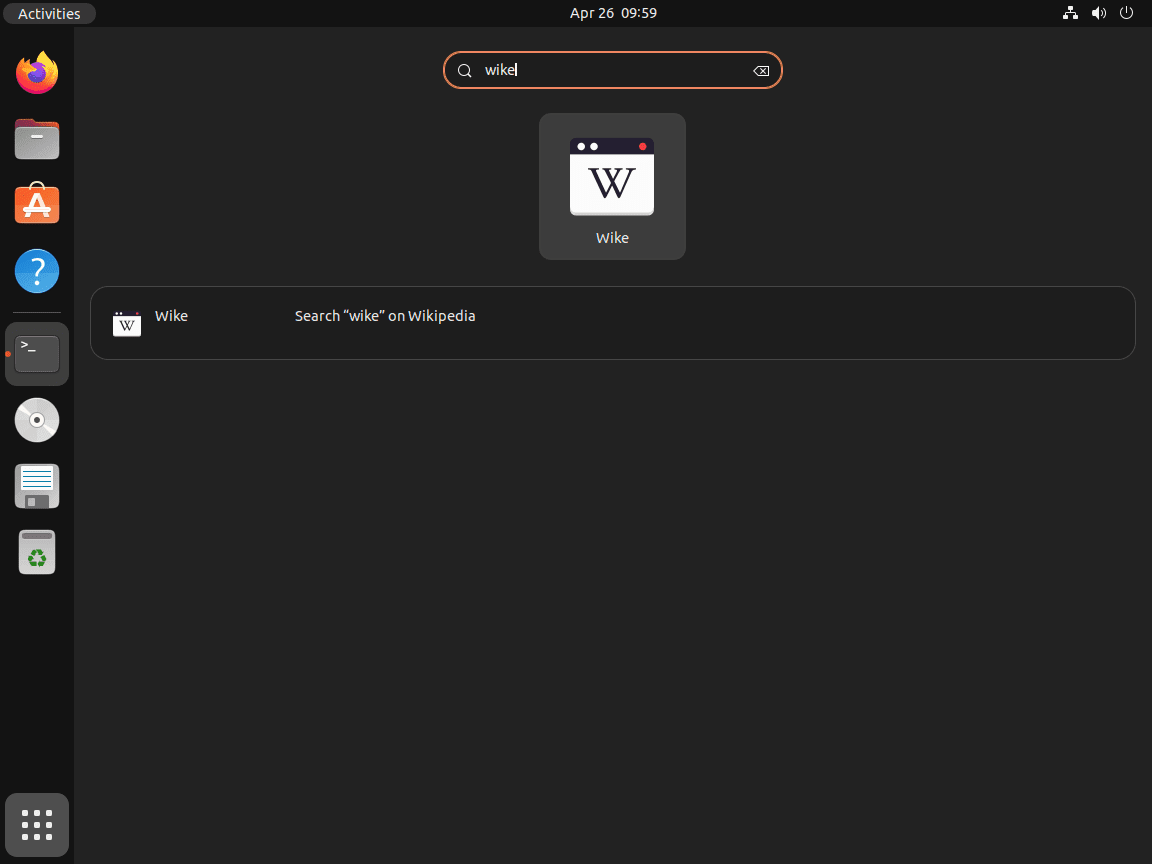
First, open your desktop’s application launcher (Activities in GNOME, or the application menu in other environments) and search for “Wike”. Then click the Wike icon to start the application.
Launch from Terminal
Alternatively, you can launch Wike from the terminal. The command differs depending on your installation method:
APT or PPA installation:
wikeFlatpak installation:
flatpak run com.github.hugolabe.WikeSnap installation:
snap run wike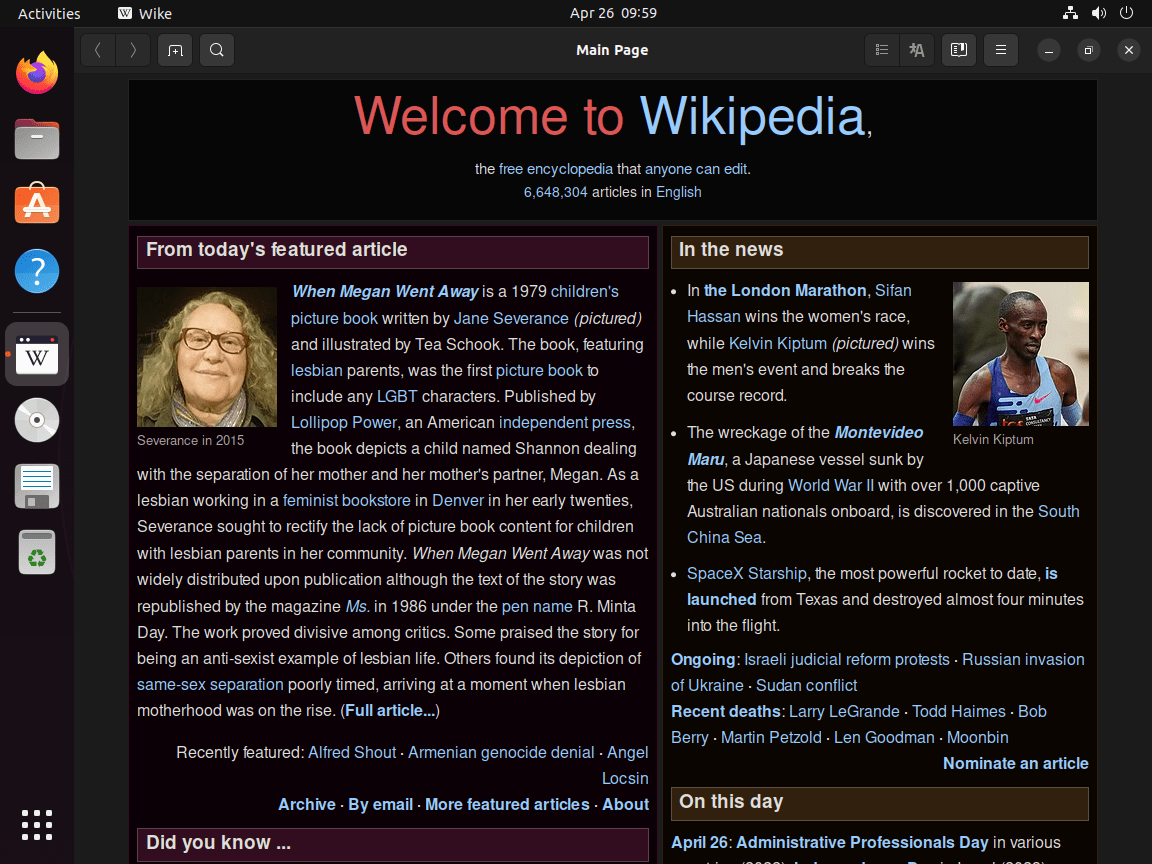
Manage Wike
The following section covers updating and removing Wike based on your installation method.
Update Wike
How you update Wike depends on your installation method:
APT or PPA installations:
For APT-based installations, Wike updates arrive with your regular system updates. To check for and apply updates:
sudo apt update && sudo apt upgradeFlatpak installation:
To update all Flatpak applications including Wike, run:
sudo flatpak updateSnap installation:
Snap applications update automatically in the background. However, to manually check for updates, run:
sudo snap refreshRemove Wike
If you need to uninstall Wike, use the command matching your installation method:
APT installation (Universe repository):
sudo apt remove wikePPA installation:
First, remove Wike and then remove the PPA to prevent future package conflicts:
sudo apt remove wike
sudo add-apt-repository --remove ppa:apandada1/wike -y
Flatpak installation:
sudo flatpak uninstall com.github.hugolabe.WikeSnap installation:
sudo snap remove wikeConclusion
At this point, you have Wike installed on your Ubuntu system, providing a distraction-free way to search and read Wikipedia in a native GNOME application. Whether you chose Flatpak for the latest features, Snap for convenience, or APT for system integration, you can now start browsing articles and creating bookmark lists. Finally, remember that Flatpak and Snap handle updates automatically, while APT installations update with your regular system upgrades.

Formatting tips for your comment
You can use basic HTML to format your comment. Useful tags currently allowed in published comments:
<code>command</code>command<strong>bold</strong><em>italic</em><blockquote>quote</blockquote>