
A missing package search on Ubuntu usually means the software lives outside the default Main and Restricted components. If you need to enable Universe and Multiverse repositories on Ubuntu, Ubuntu’s built-in repository tools let you confirm their state, turn them back on, and refresh APT without manually editing source files.
Most standard Ubuntu 26.04, 24.04, and 22.04 installs already include both components, but minimal images, custom templates, and hand-edited APT sources can leave one disabled. That makes it worth checking the active repository components before you assume a package is unavailable.
Enable Universe and Multiverse Repositories on Ubuntu
Ubuntu stores its default archive configuration in either the newer ubuntu.sources format or the older sources.list format, depending on the release and how the system was installed. The add-apt-repository command handles both layouts for you, the --yes flag accepts any confirmation prompt automatically, and --no-update keeps APT from refreshing twice while you enable both components.
Prepare Ubuntu to Enable Universe and Multiverse
Most desktop installs already include add-apt-repository. Minimal, server, and cloud images may need software-properties-common first.
sudo apt updateThese commands use
sudofor root privileges. If your account does not have sudo access yet, add a new user to sudoers on Ubuntu before continuing.
sudo apt install -y software-properties-commonThe -y flag accepts APT’s confirmation prompt automatically. If the package is already present, APT reports that it is already the newest version and leaves the system unchanged.
Enable the Universe Repository on Ubuntu
Run the next command to add Ubuntu’s community-maintained open-source component.
sudo add-apt-repository --yes --no-update universeAdding component(s) 'universe' to all repositories.
Enable the Multiverse Repository on Ubuntu
Then add the component that carries packages with licensing or redistribution restrictions.
sudo add-apt-repository --yes --no-update multiverseAdding component(s) 'multiverse' to all repositories.
Refresh APT After Enabling Universe and Multiverse on Ubuntu
Refresh the package index once after both components are enabled so APT can see the updated archive metadata.
sudo apt updateGet:28 http://security.ubuntu.com/ubuntu resolute-security/multiverse amd64 Components [212 B] Fetched 41.5 MB in 3s (14.3 MB/s) Reading package lists... Building dependency tree... Reading state information... 115 packages can be upgraded. Run 'apt list --upgradable' to see them.
Mirror URLs, transfer sizes, and upgrade counts vary. What matters is that the update completes without repository errors and returns you to the prompt.
Verify Universe and Multiverse Repositories on Ubuntu
A package-policy check is the fastest proof that both components are active. In this example, neovim comes from Universe and steam-installer comes from Multiverse.
apt-cache policy neovim steam-installerneovim: Installed: (none) Candidate: 0.11.6-1 Version table: 0.11.6-1 500 500 http://au.archive.ubuntu.com/ubuntu resolute/universe amd64 Packages steam-installer: Installed: (none) Candidate: 1:1.0.0.85~ds-2build1 Version table: 1:1.0.0.85~ds-2build1 500 500 http://au.archive.ubuntu.com/ubuntu resolute/multiverse amd64 Packages
The exact package versions differ on Ubuntu 24.04 and 22.04, but the important part is the source path ending in /universe and /multiverse. Once those lines appear, you can move on to packages such as install Neovim on Ubuntu or install Steam on Ubuntu.
Check Universe and Multiverse in Software & Updates
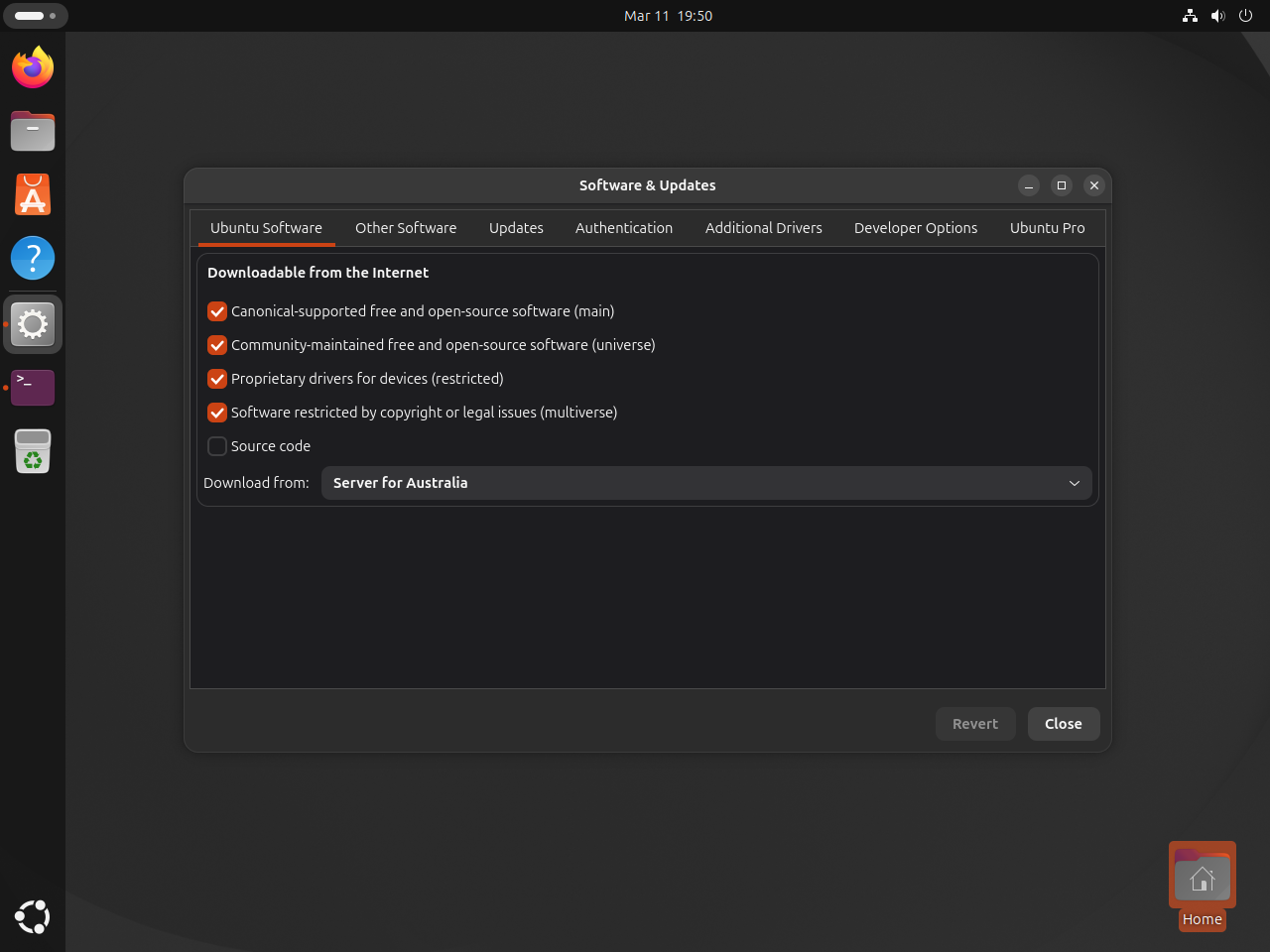
If you prefer a GUI check, open Software & Updates and review the Ubuntu Software tab. Ubuntu 26.04 may need the software-properties-gtk package before the menu entry appears.
sudo apt install -y software-properties-gtkAfter the window opens, confirm that both checkboxes stay selected.
Fix Universe and Multiverse Repository Problems on Ubuntu
Most problems come from missing repository tools, stale package indexes, or a desktop install that does not have the GUI helper installed yet.
Fix add-apt-repository Missing on Ubuntu
If Ubuntu returns add-apt-repository: command not found, install the package that provides it and rerun the enable commands.
sudo apt update
sudo apt install -y software-properties-common
The software-properties-common package provides the terminal command used for the rest of the process.
Fix Missing Packages After Enabling Universe and Multiverse on Ubuntu
If a package still shows Candidate: (none), refresh APT again and rerun the same policy check you used for verification.
sudo apt update
apt-cache policy neovim steam-installer
If the source lines still do not end in /universe or /multiverse, inspect your active Ubuntu sources for a custom mirror, an outdated release name, or a hand-edited file that removed the component.
Fix Software & Updates Missing on Ubuntu 26.04
Ubuntu 26.04 desktops can open without the GUI repository manager installed. Add the package below if you want the graphical checkboxes back in the application menu.
sudo apt install -y software-properties-gtkThe package installs the Software & Updates tool used for the optional GUI verification step.
Understand Universe and Multiverse Repositories on Ubuntu
Ubuntu splits its official archive into four main components: Main, Restricted, Universe, and Multiverse. Main and Restricted are the default supported set, while Universe and Multiverse widen what APT can install when the package you want does not live in Ubuntu’s core selection.
Universe carries community-maintained open-source software outside Ubuntu’s main support commitment. Multiverse carries packages with licensing or redistribution restrictions, which is why some proprietary or codec-related software lands there instead of in Main.
If you only need open-source packages such as neovim, Universe may be enough. If you also need packages such as steam-installer, you will want Multiverse enabled as well.
Disable Universe and Multiverse Repositories on Ubuntu
If you want to return the system to Main and Restricted only, remove both components from the active Ubuntu source definitions and refresh APT afterward. This change stops APT from using those archives for future installs and upgrades, but it does not uninstall packages that are already on the system.
Disable the Universe Repository on Ubuntu
Remove the community-maintained component first.
sudo add-apt-repository --yes --no-update --remove universeRemoving component(s) 'universe' from all repositories.
Disable the Multiverse Repository on Ubuntu
Then remove the component that carries license-restricted packages.
sudo add-apt-repository --yes --no-update --remove multiverseRemoving component(s) 'multiverse' from all repositories.
Refresh APT After Disabling the Ubuntu Repositories
Refresh the package index again so APT drops packages from both components.
sudo apt updateVerify Universe and Multiverse Are Disabled on Ubuntu
Run the next check after the update finishes. If both components are off, the fallback line confirms that no active Universe or Multiverse entries remain.
cat /etc/apt/sources.list /etc/apt/sources.list.d/ubuntu.sources 2>/dev/null | grep -E "^(Components:.*(universe|multiverse)|deb .*(universe|multiverse))" || echo "No active universe or multiverse entries found."No active universe or multiverse entries found.
On Ubuntu 26.04 and 24.04, enabled components appear as Components: lines from ubuntu.sources. On Ubuntu 22.04, the same command prints active deb lines from /etc/apt/sources.list instead.
Ubuntu Universe and Multiverse FAQ
No. Disabling Universe and Multiverse only stops APT from using those components for future installs and upgrades. Packages already installed from those archives stay on the system until you remove them yourself.
Universe contains community-maintained open-source packages outside Ubuntu’s main support commitment. Multiverse contains packages with licensing or redistribution restrictions, so you should review package terms before installing software from it.
No. Enable only the component you actually need. Packages such as neovim come from Universe, while packages such as steam-installer come from Multiverse.
The menu entry comes from the software-properties-gtk package. If it is missing on your desktop install, add it with sudo apt install -y software-properties-gtk and reopen the application menu.
Conclusion
Universe and Multiverse repositories are enabled on Ubuntu again, so APT can see packages beyond the default Main and Restricted set. When you are ready to use them, follow the guides to install Neovim on Ubuntu or install Steam on Ubuntu, and keep software-properties-common installed if you manage repository components from the terminal regularly.

Formatting tips for your comment
You can use basic HTML to format your comment. Useful tags currently allowed in published comments:
<code>command</code>command<strong>bold</strong><em>italic</em><blockquote>quote</blockquote>